Best Books on Reading Financial Statements for M&A Buyers: 4 Picks to Spot Red Flags
Bottom line: For reading financial statements as an M&A buyer, Zaimu 3-hyo Ittai Rikai-ho is the first book to grab.
Most people who get burned in small M&A deals don't fail because they couldn't understand the numbers—they fail because they thought they understood them. Browsing a seller's financial statements without grasping their underlying structure is like reading a contract in a foreign language with a pocket dictionary: you pick up words, but you miss the traps.
This guide reviews 4 books through one specific lens: can an M&A buyer use this to spot fraud and red flags in a seller's financials? Not stock-picking analysis. Not bookkeeping for accountants. Just the books that help a non-accountant sit down with a seller's three statements and say, "wait, something's off here."
All four books work even if you have zero bookkeeping background. The goal isn't to become an accountant—it's to spend one hour with a target's financials and catch the anomalies worth escalating to a CPA.
Verdict: Best Picks by Use Case
Complete beginner preparing for their first M&A DD
Zaimu 3-hyo Ittai Rikai-ho
The only ¥990 book that systematically teaches three-statement interplay. Everything else is a detour without this foundation.
Already know the basics; want real-company reading practice
Kaikei Quiz: World's Most Fun Financial Statement Book (Revised)
Solving quizzes with Amazon's and Toyota's actual numbers trains your 'something's off' instinct. Ideal second read.
Thinking about post-acquisition management; want an owner-operator's mindset on numbers
Inamori Kazuo's Practical Management: Real-World Accounting (New Edition)
Inamori's philosophy of tracking costs to the yen builds the instinct to question a seller's cost structure as a buyer.
Need a fast ratio reference right before a DD meeting
Financial Statement Analysis in 100 Minutes: Super Primer 2026
Compact coverage of formulas and industry benchmarks makes it a reliable calculator-in-hand reference the night before DD.
Minimizing budget; want two books to cover the DD fundamentals
Zaimu 3-hyo Ittai Rikai-ho + Inamori Practical Management
At ¥1,980 combined, this pair covers both structural understanding and owner-operator number sense—the lowest-cost combination that does the job.
Scoring Criteria
How directly the book helps a small-M&A buyer identify fraud, red flags, and cash-flow anomalies during due diligence.
Whether a reader with zero to basic bookkeeping knowledge can read it cover-to-cover without giving up, judged by diagrams, examples, and narrative.
How effectively the book teaches the interplay between the balance sheet, income statement, and cash flow statement—beyond definitions.
Information density and practical value relative to price (range: ¥990–¥1,760).
Comparison Table
| Item | 【新版】財務3表一体理解法 | 【改訂版】会計クイズを解くだけで財務3表がわかる 世界一楽しい決算書の読み方 | 稲盛和夫の実学 新装版 経営と会計 | 100分でわかる!決算書「分析」超入門 2026 |
|---|---|---|---|---|
| Score | 92 | 82 | 73 | 75 |
| Verdict | The single best book for burning the three-statement map into your brain—unmatched value at ¥990. | A training book for building real-company reading instincts—significantly more effective as your second read. | Read it as a philosophy book on weaponizing numbers as an owner-operator, not as a DD tool—effective for buyer mindset. | Excellent financial ratio reference. Keep it on hand as a pre-DD checklist companion, not as a standalone primer. |
| Price Range | ¥990 | ¥1,760 | ¥990 | ¥1,100 |
| Author | Katsunori Kunisada | Otemachi no Random Walker | Kazuo Inamori | Yoshitaka Saeki |
| Publisher | Asahi Shimbun Publications (Asahi Shinsho) | KADOKAWA | Nikkei BP / Nikkei Business Jinbunko | Asahi Shimbun Publications |
| Pages | approx. 280 | approx. 320 | approx. 240 | approx. 190 |
| Published | 2021 | 2023 (revised edition) | 2023 (new edition) | 2026 |
| Price | ¥990 (tax included) | ¥1,760 (tax included) | ¥990 (tax included) | ¥1,100 (tax included) |
| Difficulty | ★★☆☆☆ (zero bookkeeping background OK) | ★★☆☆☆ (zero bookkeeping background OK) | ★☆☆☆☆ (no accounting knowledge needed) | ★★☆☆☆ (zero bookkeeping background OK) |
Product Details

【新版】財務3表一体理解法
朝日新聞出版 · ¥990
First-time M&A buyers with zero to basic accounting knowledge who need to understand how the three statements connect
Good
- ✓Tracks the same transaction across all three statements simultaneously—you feel the linkage, not just read about it
- ✓Built around a single SME case study that closely mirrors the financials you'd see in a real small-M&A deal
- ✓280 pages for ¥990—among the highest info density in the new-book (shinsho) format
- ✓Explains counterintuitive points like 'why depreciation doesn't reduce cash' in plain language
Bad
- ×Does not directly address fraud detection—needs to be paired with a DD checklist
- ×Lacks real-company examples, so it can feel abstract when you try to apply it to an actual target
- ×2021 edition predates the updated lease accounting standards applied from 2024
Score Breakdown
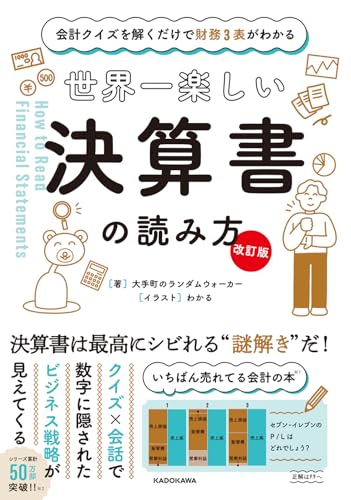
【改訂版】会計クイズを解くだけで財務3表がわかる 世界一楽しい決算書の読み方
KADOKAWA · ¥1,760
Buyers who've already grasped the basics and want to practice reading actual company financials
Good
- ✓Uses real companies (Amazon, Apple, Toyota, Uniqlo) in quiz format—you get actual reading practice, not theory
- ✓Builds intuition for 'gross margin differences reflect business model differences'—a critical M&A lens
- ✓Almost every page has a visual across 320 pages; dropout rate is low
- ✓Industry-level financial structure comparisons help you judge whether a target's numbers are 'normal'
Bad
- ×Quiz companies are mostly large listed firms—the financials look quite different from the private SMEs you'd buy in small M&A
- ×Cash flow statement coverage is shallower than the other two statements; you'll need supplementary reading for CF anomaly detection
- ×At ¥1,760 it's the priciest of the four; role should be practice, not foundation-building
Score Breakdown

稲盛和夫の実学 新装版 経営と会計
日経BP · ¥990
Buyers who want to build an owner-operator's number-driven mindset in preparation for post-acquisition management
Good
- ✓Kyocera's 'maximize revenue, minimize costs' accounting philosophy sharpens your owner-operator mindset as a buyer
- ✓Contains passages that build instinctive wariness toward inventory padding and inflated receivables
- ✓High-fidelity portrayal of what SME owners actually do with numbers—useful for modeling seller psychology
- ✓240 pages at ¥990; tied for top cost-performance among the four
Bad
- ×Not a systematic guide to the three financial statements—reading it for that purpose will disappoint
- ×Heavy Kyocera/manufacturing context; IT or service-sector buyers may struggle to relate
- ×M&A and acquisition scenarios are virtually absent—its DD value is indirect at best
Score Breakdown

100分でわかる!決算書「分析」超入門 2026
朝日新聞出版 · ¥1,100
Buyers who already understand the basics and need a fast reference for ratio-based financial analysis before a DD meeting
Good
- ✓Covers key M&A financial ratios—ROE, current ratio, equity ratio—efficiently in one sitting
- ✓2026 edition uses current listed-company data, giving you a concrete sense of industry averages
- ✓At 190 pages, thin enough to skim through right before a DD session as a quick reference
- ✓Formula + interpretation pairs make it usable as a calculator-in-hand reference during analysis
Bad
- ×Focused on analysis techniques—not suitable as a first book for learning how the three statements interconnect
- ×Targets listed-company annual securities reports; significant gap from the tax-return-based financials common in private SME deals
- ×Annual revision cycle means this edition will be superseded next year
Score Breakdown
Choose by Use Case × Budget
| Use Case | Up to ¥1,000 (one book) | Up to ¥2,000 (two books) | Up to ¥3,000 (two to three books) | ¥3,000+ (all four books) |
|---|---|---|---|---|
| Learn the three-statement basics as fast as possible | Zaimu 3-hyo Ittai Rikai-ho | — | — | — |
| Build owner-operator mindset from a management philosophy angle | Inamori Practical Management (New Edition) | — | — | — |
| Build from basics to practical DD readiness for small M&A | — | Zaimu 3-hyo Ittai Rikai-ho + Financial Analysis in 100 Minutes | — | — |
| Complete training including real-company reading practice | — | — | Zaimu 3-hyo + Kaikei Quiz Book (+ Inamori) | — |
| Full financial literacy kit for a serious M&A buyer | — | — | — | All four. Recommended order: ① Zaimu 3-hyo → ② Inamori → ③ Kaikei Quiz → ④ 100-Min Analysis |
FAQ
Conclusion
Final Take: The One Book to Pick Up Before Your First DD
After comparing all four, the verdict is clear: start with Zaimu 3-hyo Ittai Rikai-ho. At ¥990, nothing else teaches the mechanical interplay of BS, P&L, and CF with the same efficiency.
Here's the practical sequence:
- Zaimu 3-hyo Ittai Rikai-ho — internalize how the three statements move together (two weekend days)
- Kaikei Quiz book — practice reading real companies' numbers and develop your "something's off" instinct
- Pair both with the Financial DD Checklist and Red Flags Guide on this site when you sit down with actual target financials
The Inamori book earns its place as a mindset reset—it reminds you why the numbers matter at all. The 100-min Analysis Primer works best as a third or fourth read, once you're ready to work with real listed-company annual reports.
Financial statements only become a weapon once you can actually read them. Before you spend ¥200,000 on external DD, spend ¥990 on the foundation.
Author's Related Implementations
The author has built 1 related interactive demos.
This page contains Amazon Associates affiliate links. Purchases may earn sakimyto a commission, but this does not affect product ratings or rankings. Prices may vary — check Amazon for the latest.