Best SQL Books for Beginners 2025: 3 Picks Ranked by Hands-On Learning
Conclusion: For SQL books beginner picks, Sukkiri Wakaru SQL Nyumon 4th Edition is the definitive first choice.
Buying an SQL book only to give up halfway through — this pattern repeats itself constantly among beginners. The root cause almost always falls into one of three traps.
① Choosing a book that rewards reading, not doing Visually rich books are enjoyable to read, but without drills to type through, the content evaporates within a week. SQL is like playing guitar: reading sheet music doesn't build muscle memory — actually pressing the strings does.
② Picking a book misaligned with your actual goal "I want to write SQL" and "I want to understand database design" require completely different books. If your goal is passing a technical interview or automating a CSV workflow, you need high exercise density, not conceptual depth.
③ Ignoring publication year SQL itself is a mature language, but environment setup instructions, MySQL/PostgreSQL version-specific syntax, and tooling references go stale fast. Getting stuck on a 2016 installation guide is a common and avoidable pitfall.
This article draws on experience building 200+ interactive coding demos and making data-driven decisions across three startup exits. Each of the three books is scored across four axes — exercise density, real-world relevance, beginner-friendliness, and value for money — so you finish reading knowing exactly which book to buy next.
Verdict: Best Picks by Use Case
Tech career change / interview prep
Sukkiri Wakaru SQL Nyumon 4th Ed.
256 drills directly build the write-on-demand SQL skill tested in interviews. 2024 publication date means fewer setup headaches.
Replacing manual CSV work with SQL queries
Sukkiri Wakaru SQL Nyumon 4th Ed.
Maximum hands-on practice for SELECT, GROUP BY, and JOIN — the exact queries needed to replace Excel/CSV workflows.
Systematic read-through of SQL syntax
SQL Zero kara Hajimeru 2nd Ed.
Clear logical progression with solid 'why' explanations. Being the classic text means abundant supplementary resources online.
Understanding DB design and normalization
Ouchi de Manaberu Database no Kihon
The deepest conceptual coverage of normalization, ER diagrams, and transactions — best used as a foundation before heavy query practice.
Quick weekend overview to get the SQL big picture
Ouchi de Manaberu Database no Kihon
At 272 pages, it's completable in 2–3 weekend sessions — the most efficient way to build a mental map of how databases work.
Scoring Criteria
Number of drills, exercises, and typed code. Does it build the ability to write SQL from scratch?
Coverage of SELECT, JOIN, aggregation, subqueries — how quickly can you apply it at work?
Can a complete beginner follow along? Clarity of diagrams, tone, and assumed knowledge level.
Price vs. page count, exercise volume, and bonus materials. Worth the investment for a beginner?
Comparison Table
| Item | スッキリわかるSQL入門 第4版 ドリル256問付き! | SQL 第2版 ゼロからはじめるデータベース操作 | おうちで学べるデータベースのきほん |
|---|---|---|---|
| Score | 92 | 78 | 67 |
| Verdict | The definitive first book for beginners who want to write SQL fast — no contest | The classic systematic SQL reference — still solid, but verify setup steps against current docs | Ideal for building conceptual foundations before you start writing queries — not a standalone first book |
| Price Range | ¥2,640 | ¥2,530 | ¥2,508 |
| Author | Kiyotaka Nakayama, Rieko Iida | Mick | Mick, Meiji Kimura |
| Publisher | Impress | Shoeisha | Shoeisha |
| Pages | 528 | approx. 380 | 272 |
| Year | 2024 | 2016 | 2015 |
| Drills | 256 exercises | End-of-chapter exercises (5–10 per chapter) | Minimal (diagram and concept-focused) |
| Supported DB | MySQL / PostgreSQL / SQLite | MySQL / PostgreSQL / Oracle / SQL Server | RDBMS concepts (not tied to a specific DB engine) |
Product Details

スッキリわかるSQL入門 第4版 ドリル256問付き!
インプレス · ¥2,640
Career-changers targeting tech roles, beginners who learn best by typing, not reading
Good
- ✓256 drills — the highest exercise count of any Japanese SQL beginner book
- ✓Published 2024, so MySQL/PostgreSQL setup instructions reflect current versions
- ✓528 pages for ¥2,640 — roughly ¥10 per drill, exceptional value
- ✓Character-dialogue format makes it accessible to non-technical readers
Bad
- ×528 pages can feel overwhelming before you find your reading rhythm
- ×Performance tuning and index optimization require a supplementary book
- ×Heavy drill focus means some 'why does this work' theory is underexplained
Score Breakdown
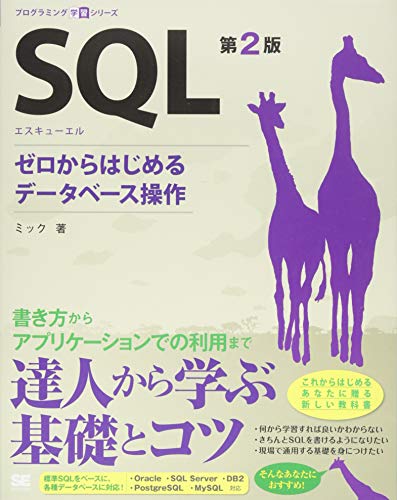
SQL 第2版 ゼロからはじめるデータベース操作
翔泳社 · ¥2,530
Readers who want a logical, structured syntax overview; pairs well as a companion to Sukkiri Wakaru SQL
Good
- ✓Systematic coverage of SELECT, WHERE, GROUP BY, JOIN, and subqueries
- ✓Logical structure helps readers understand 'why' not just 'what'
- ✓The definitive Japanese SQL classic — a large community of supplementary resources exists online
- ✓End-of-chapter exercises let you verify comprehension before moving on
Bad
- ×Published 2016 — setup instructions may not work with current MySQL out of the box
- ×Fewer drills than Sukkiri Wakaru SQL; less total writing practice
- ×No major revision since 2nd edition; modern SQL features like window functions are underrepresented
Score Breakdown

おうちで学べるデータベースのきほん
翔泳社 · ¥2,508
Anyone wanting to understand relational DB design thinking; best read alongside or before a drill-heavy book
Good
- ✓Best conceptual coverage of all three — 'what is a DB and why do we normalize?' is explained with real care
- ✓Co-authored by Mick and a working engineer; DB design perspective is unusually strong for an intro book
- ✓272 pages — completable in a few focused weekends
- ✓Accessible to non-engineers like PMs and marketers who want to understand data infrastructure
Bad
- ×Published 2015 — no coverage of cloud databases like BigQuery or Snowflake
- ×Very few drills; not effective for building hands-on SQL writing skills
- ×Design and concept-heavy; not the right choice if technical interview prep is the goal
Score Breakdown
Choose by Use Case × Budget
| Use Case | Under ¥3,000 (single book budget) | Under ¥6,000 (two-book budget) |
|---|---|---|
| Zero SQL experience, learn by typing | Sukkiri Wakaru SQL Nyumon 4th Ed. | — |
| Prefer logical read-through over drill-heavy practice | SQL Zero kara Hajimeru 2nd Ed. | — |
| Want to understand DB design before writing queries | Ouchi de Manaberu Database no Kihon | — |
| Career change into tech / serious skill building | — | Sukkiri Wakaru SQL 4th Ed. + SQL Zero kara Hajimeru 2nd Ed. |
| Full-stack DB learning including design and queries | — | Ouchi de Manaberu + Sukkiri Wakaru SQL 4th Ed. |
FAQ
Conclusion
Wrap-Up: The "Write → Read → Apply" SQL Learning Roadmap
Here's the one-line takeaway for each book:
- Sukkiri Wakaru SQL Nyumon 4th Ed. — The fastest path to hands-on SQL fluency via 256 drills
- SQL Zero kara Hajimeru 2nd Ed. — The definitive syntax reference; double-check setup instructions against current versions
- Ouchi de Manaberu Database no Kihon — The bridge into DB design thinking, best read after you can write basic queries
Recommended learning roadmap:
① Sukkiri Wakaru SQL (2–3 months, type through every drill)
    ↓
② Apply queries on real work data (1–2 months)
    ↓
③ Zero kara Hajimeru or Ouchi de Manaberu (fill in weak spots)
    ↓
④ Write queries against a production DB, get team code reviews
If someone asks for a single recommendation, the answer is Sukkiri Wakaru SQL Nyumon 4th Edition without hesitation. Published in 2024, with 256 drills as a concrete, countable learning target, it removes all ambiguity about what "done" looks like. Time spent debating which book to buy is time not spent writing SQL.
Author's Related Implementations
The author has built 3 related interactive demos.
This page contains Amazon Associates affiliate links. Purchases may earn sakimyto a commission, but this does not affect product ratings or rankings. Prices may vary — check Amazon for the latest.