Best Python Books for Beginners 2025: Top 4 Picks to Avoid Burnout
Bottom line: for Python beginners, Minna no Python 5th Edition is the optimal first book.
That said — not for everyone.
I've built roughly 200 interactive demos, including sorting visualizers, a Snake game, maze generators, and pathfinding simulations. Along the way, I cross-referenced more than 7 Python beginner books. The pattern I noticed: whether you burn out depends less on difficulty and more on whether the book matches your actual goal.
Someone who wants to build things buys a dense reference-style grammar book. Someone who wants solid fundamentals picks up a thin dialogue-based primer and hits a ceiling fast. Neither book is bad — the selection process was broken.
In this article, I evaluate 4 books available in 2025 through one lens: what can you actually build after reading it? Beyond price and page count, I'll give a concrete "this one book" recommendation for each goal — career change, side hustle, and data science.
Demos like my sorting visualizer and Snake game were rebuilt after I deeply understood Python's core algorithms. I'll tell you which book gets you closest to that level.
Verdict: Best Picks by Use Case
Zero experience — avoiding burnout is the #1 priority
Python 1-nen-sei 2nd Edition
208 pages, dialogue format, and ¥2,200 — the lowest barrier of entry. Getting that first 'it works!' moment is the only goal at this stage, and this book is designed for exactly that.
Career change — need systematic Python skills
Minna no Python 5th Edition
Published 2025, ~500 pages covering beginner to intermediate in one volume. Includes classes, exception handling, and library usage — exactly what you need to credibly claim Python skills in a job interview.
Side hustle / automation — focused, short-term learning
Minna no Python 5th Edition
Chapters on file I/O and web scraping map directly to automation use cases. Among the four books, it delivers the best all-around score for practical, career-applicable outcomes.
Prior coding experience — want a lasting reference
Dokushuu Python 2nd Edition
At ~600 pages with rich exercises, it covers beginner to intermediate comprehensively. For those with prior language experience, the high text density is a feature not a bug — it also works well as a lookup reference.
Theory-first learner — wants to understand the 'why'
Shin Meikai Python Nyuumon 2nd Edition
Boh Shibata's signature rigorous style from the C-language Meikai series translates directly to Python here. It clicks for readers who won't move on until they understand why the code works — not just that it does. ¥2,970 is a fair price for the depth.
Scoring Criteria
Clarity of explanations, use of diagrams/dialogue, and how well the book prevents beginners from getting stuck
Whether readers can write working programs independently after finishing, and how practical/extensible the sample code is
Python 3 compatibility, risk of outdated content as of 2025, and coverage of standard syntax and libraries
Whether price is justified by page count, content depth, and learning ROI — especially for career-changers and side-hustlers
Comparison Table
| Item | みんなのPython 第5版 | Python1年生 第2版 体験してわかる!会話でまなべる!プログラミングのしくみ | 独習Python 第2版 | 新・明解Python入門 第2版 |
|---|---|---|---|---|
| Score | 88 | 79 | 81 | 77 |
| Verdict | The lowest-risk first choice for beginners in 2025 | The book that gets total novices past their very first mental wall | A lasting desk reference — but may be too dense as your very first book | A precise, logic-first book that clicks for analytical, STEM-minded readers |
| Price Range | ¥3,300 | ¥2,200 | ¥3,608 | ¥2,970 |
| Author | Jun Shibata | Yoshihisa Mori | Yoshihiro Yamada | Boh Shibata |
| Publisher | SB Creative | Shoeisha | Shoeisha | SB Creative |
| Pages | approx. 500 | 208 | approx. 600 | approx. 470 |
| Year | 2025 | 2022 | 2025 | 2025 |
| Price | ¥3,300 (tax incl.) | ¥2,200 (tax incl.) | ¥3,608 (tax incl.) | ¥2,970 (tax incl.) |
| Target Level | Complete beginner to intermediate | Absolute beginners (zero programming experience) | Beginner to intermediate (requires motivation to self-study) | Beginner to intermediate (best for theory-first learners) |
Product Details
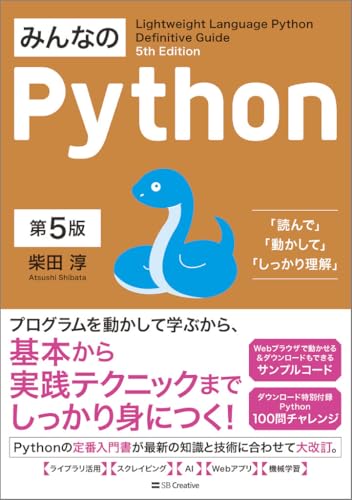
みんなのPython 第5版
SBクリエイティブ · ¥3,300
Working adults who want a structured foundation with career goals in mind
Good
- ✓Published 2025 — fully up to date with Python 3.12 syntax
- ✓~500 pages covering beginner to intermediate in a single volume
- ✓Well-balanced diagrams and examples without excessive padding
- ✓Practical use cases (web scraping, file I/O) included in dedicated chapters
Bad
- ×No dialogue format — the first 50 pages can feel dry for total novices
- ×Thin coverage of machine learning and data science topics
Score Breakdown
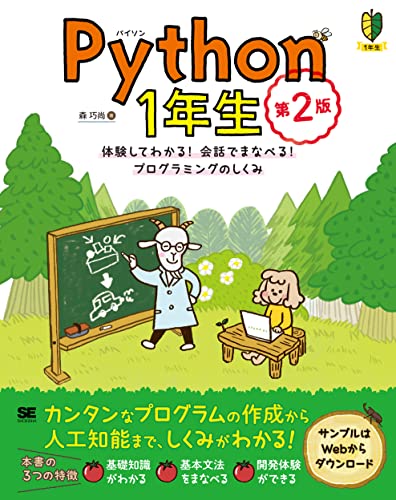
Python1年生 第2版 体験してわかる!会話でまなべる!プログラミングのしくみ
翔泳社 · ¥2,200
Complete beginners who feel intimidated by programming
Good
- ✓Dialogue format and only 208 pages — readable in a week
- ✓¥2,200, the cheapest of the four — low risk for a trial purchase
- ✓Introduces variables, loops, and functions without triggering cognitive overload
- ✓Step-by-step Python installation guide prevents environment setup failures
Bad
- ×208 pages is too thin — finishing it typically leaves you at 'Hello World + basic math' level
- ×Published 2022, so Python 3.12+ features are not covered
- ×One book alone won't get you to career-change or freelance-ready skill level
Score Breakdown
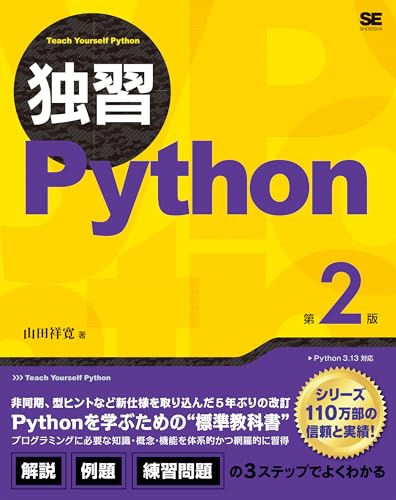
独習Python 第2版
翔泳社 · ¥3,608
Those with some prior coding experience or strong self-discipline to finish a dense 600-page book
Good
- ✓Published 2025, ~600 pages — the largest and most up-to-date of the four
- ✓Rich end-of-chapter exercises build a habit of active practice, not just reading
- ✓Deep standard library coverage makes it a lasting reference beyond initial study
- ✓Covers data types, exception handling, and class design — a solid bridge to intermediate level
Bad
- ×~600 pages can feel overwhelming as a first book
- ×Few dialogues or illustrations — high text density demands patience to read through
- ×¥3,608, the most expensive of the four — hard to justify if you're unsure you'll stick with it
Score Breakdown
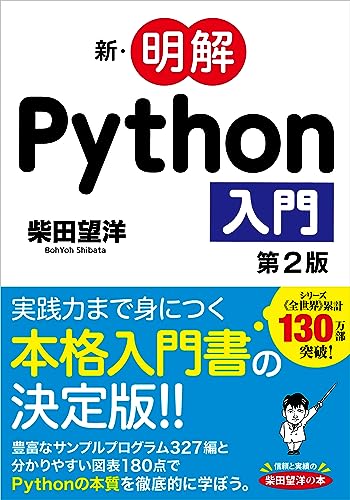
新・明解Python入門 第2版
SBクリエイティブ · ¥2,970
Theory-first learners who need to understand the 'why' behind every line before moving on
Good
- ✓Published 2025, ~470 pages — fresh content
- ✓Author Boh Shibata's 'Meikai' series has a strong reputation for rigorous grammar explanation (originally for C)
- ✓¥2,970 — good balance of price and page count
- ✓Carefully traces 'why this code works,' building deeper conceptual understanding
Bad
- ×The 'Meikai' style appeals more to STEM/C-language backgrounds — can feel stiff for non-engineers
- ×Emphasizes grammar logic over practical examples — not ideal for 'I just want to build things' types
- ×Fewer beginner-friendly hooks compared to the other three books — harder to stay motivated early on
Score Breakdown
Choose by Use Case × Budget
| Use Case | Under ¥2,500 | Under ¥3,500 | Under ¥4,000 | Certainty over price |
|---|---|---|---|---|
| Zero experience — just want to try | Python 1-nen-sei 2nd Ed. (¥2,200) | — | — | — |
| Career change or side hustle — systematic learning | — | Minna no Python 5th Ed. (¥3,300) | — | — |
| Theory-first learner — deep grammar understanding | — | Shin Meikai Python Nyuumon 2nd Ed. (¥2,970) | — | — |
| Prior coding experience — want a comprehensive reference | — | — | Dokushuu Python 2nd Ed. (¥3,608) | — |
| Can't decide — want the safest bet | — | — | — | Minna no Python 5th Ed. (¥3,300) |
FAQ
Conclusion
Wrap-Up: Learning Roadmap and Next Steps
Looking back at all four books, each has a clear role:
| Goal | Recommended Book |
|---|---|
| Zero experience → feel what "building something" means | Python 1-nen-sei 2nd Ed. |
| Build a solid foundation, beginner to intermediate, in one book (2025) | Minna no Python 5th Ed. |
| A long-lived desk reference you'll keep returning to | Dokushuu Python 2nd Ed. |
| Understand grammar logic rigorously | Shin Meikai Python Nyuumon 2nd Ed. |
Post-Reading Roadmap
Step 1 (Read): Pick one book. Type out every code sample by hand — no copy-paste.
Step 2 (From copy to remix): Modify the book's examples to produce something you find interesting. If you can build something like my Game of Life demo or a pathfinding visualizer, your fundamentals are solid.
Step 3 (Apply to a real problem): Career changers → AtCoder B-level problems. Side hustlers → automate one repetitive task at your current job. Data science → finish the Kaggle Titanic competition end-to-end.
Spending ¥3,000–3,600 on a book is a small bet. Land one freelance project with the skills it gives you and the ROI exceeds 10×. Stop agonizing over which book to buy — pick one and start typing.
Author's Related Implementations
The author has built 6 related interactive demos.
This page contains Amazon Associates affiliate links. Purchases may earn sakimyto a commission, but this does not affect product ratings or rankings. Prices may vary — check Amazon for the latest.